Business simulation games with stock markets add another layer of strategy by letting players buy shares, track price movements, earn dividends, and manage investment portfolios alongside their businesses. These mechanics introduce players to virtual investing and show how market decisions can influence progress in a simulated business world.
Games like Billionaire Business Empire combine stock market features with business ownership and real estate, giving players more ways to build virtual wealth.
How Do Stock Markets Work in Business Simulation Games?
Business simulation games with stock markets give players another way to use their virtual money beyond purchasing and upgrading businesses. Instead of relying exclusively on operating a company, players can buy shares, monitor price movements, receive dividends when the game supports them, and decide when to sell or reallocate their capital.
This changes the central gameplay question from "Which business should I build?" to a broader one: "Where should I allocate my money to achieve my next goal?"
A stock market introduces a different kind of decision into the simulation. A business purchase may offer a defined income stream under the game's rules, while a stock investment can involve both dividend income and changes in the share price.
The relative importance of those outcomes depends on the game's mechanics.
Some games use stocks as a simple way to increase virtual wealth. Others make investing a more developed system with market information, portfolio management, and changing asset values.
Understanding these differences helps explain why stock markets can make business simulation games more varied, and why the quality of the investing system matters as much as its presence.
Why Add a Stock Market to a Business Simulation?
Without a stock market, a business simulation may center on building, upgrading, and expanding directly owned operations. Adding stocks creates an alternative use for the player's resources.
A player can now compare the potential benefits of expanding an existing business with the potential benefits of purchasing shares. These options may produce different income patterns, require different levels of involvement, or contribute to progression in different ways.
The stock market also separates two activities that can otherwise feel similar: operating a business and owning a financial asset.
When players purchase a business, they generally interact with its development and income systems. When they purchase shares, they interact with the game's investment system instead.
The player may not control the underlying company, but its simulated stock performance can still affect the value of the investment.
This additional layer creates more ways to allocate capital without requiring the player to manage every business directly.
The Main Stock Market Mechanics in Business Games
Not every game implements stocks in the same way. However, several mechanics determine how much investing affects the overall experience.
Buying and Selling Shares
The most basic stock market mechanic allows players to exchange virtual money for shares in a company.
The purchase reduces the player's available cash and adds an investment to their holdings. Selling shares reverses the transaction, returning virtual money according to the game's current selling rules.
This creates a decision that does not exist in the same form when upgrading a business: the player must consider whether to keep capital invested or make it available for another opportunity.
For example, a player may have enough money to buy additional shares or upgrade an existing business. Each option changes the player's virtual financial position differently.
The decision depends on the game's mechanics, the player's current holdings, and the goal they are trying to achieve.
Stock Prices and Price Movements
Some stock market simulation games assign prices that can change over time or according to in-game conditions.
When a share price rises, an existing holding may become more valuable. When the price falls, its value may decrease.
This introduces a new source of uncertainty into progression. Unlike a fixed-cost upgrade, a stock investment may change in value after purchase.
However, not all games simulate markets with the same degree of complexity. Some use relatively simple price trends, while others include additional variables or market events.
Players should therefore learn how the individual game calculates price changes rather than assume that every stock market follows the same rules.
Dividends and Investment Income
Dividends can create a second source of return from stock ownership.
In a game that supports dividends, a player may receive virtual income from holding shares. This can make an investment useful even when the player's objective is not to sell the shares immediately.
Dividend mechanics also create a distinction between income from holding an asset and gains from selling it.
These are separate concepts. A share might generate dividends while its price changes, and the total outcome depends on how the game handles both.
Some games may simplify dividend calculations or make returns predictable. Others may connect payouts to additional simulated conditions.
The important point is that dividends can change how players evaluate an investment. The decision is no longer necessarily about buying low and selling high; it may also involve the income earned while holding the shares.
Stock Analytics and Company Information
A stock market becomes more engaging when it provides information that helps players compare available investments.
Depending on the game, this might include share prices, dividend rates, price trends, company information, or analytical screens.
These details give players a basis for comparing opportunities instead of selecting stocks without considering their displayed characteristics.
However, having more statistics does not automatically make a simulation more realistic. The information must have a meaningful relationship with the game's outcomes for players to use it strategically.
If the game displays a price trend, for example, players need to understand what that trend represents and whether it has any reliable predictive value under the game's rules.
Portfolios and Multiple Holdings
A portfolio groups the player's investments into a single view.
This makes it easier to see which shares are owned and decide whether to purchase more, sell an existing holding, or allocate money elsewhere.
When a game supports multiple investments, the player can also compare the role of different holdings within the overall progression strategy.
Portfolio management does not automatically mean the game models real-world diversification accurately. It simply gives the player a way to manage more than one investment as part of a larger virtual financial position.
How Investing Changes the Business Simulation Gameplay Loop
A business simulation without stocks may use a relatively direct progression loop:
Earn money - purchase or upgrade a business - generate more income - expand
Adding a stock market creates another possible route:
Earn money - evaluate shares - invest - monitor holdings - receive dividends or respond to price changes - sell or reinvest
These systems can operate alongside each other.
The player must now decide not only how to increase income, but also how to divide capital between different opportunities.
This can make the game more interesting because there may be several valid routes to progression. One player might prioritize improving existing businesses, while another might allocate some of their virtual money to shares.
Neither approach is automatically superior. Its effectiveness depends on the game's return calculations, purchase costs, progression requirements, and investment rules.
Business Ownership vs. Stock Investing
Although both mechanics involve putting virtual money into something that may generate value, they can serve different roles within a game.
Feature | Owning a Business | Investing in Stocks |
|---|---|---|
Main Activity | Purchase and manage a business | Buy and manage share holdings |
Income Model | May provide business revenue or daily income | May provide dividends, depending on the game |
Value Changes | May depend on upgrades, income, or sale rules | May depend on simulated share-price movements |
Player Interaction | Can involve upgrades, collections, and operational decisions | Can involve purchases, portfolio monitoring, and selling |
Main Trade-Off | How much to invest in the operation | How much capital to allocate to shares |
Potential Progression Role | Expand productive business assets | Build investment holdings or pursue simulated returns |
These differences are general patterns rather than universal rules. Some games give businesses complex operating systems, while others reduce ownership to a purchase and an income counter. Stock markets can be equally simple or sophisticated.
The key distinction is the kind of decision the player makes.
Business ownership focuses on the operation itself; stock investing focuses on the financial asset and its behavior within the game's system.
What Makes a Stock Market Simulation Strategic?
A stock market is more than a decorative feature when the player's investment choices affect future options.
Several design elements can make investing more strategic.
Limited capital: Buying shares means the same money cannot be used elsewhere.
Different investment characteristics: Stocks may have different prices, dividend rates, or displayed trends.
Changing outcomes: If prices move, the value of holdings may change after purchase.
Timing decisions: Players may need to decide whether to hold, sell, or wait before making another purchase.
Interaction with other systems: Investment decisions become more consequential when they compete with business upgrades, property purchases, or other uses of capital.
The combination of these mechanics creates a more connected economy. Players have to compare opportunities instead of following one fixed route to growth.
That said, complexity alone does not guarantee strategic depth. A well-designed simple market can create meaningful decisions, while a market filled with statistics may offer little real choice if all investments behave identically.
Case Study: The Stock Market in Billionaire Business Empire
Billionaire Business Empire provides a practical example of how a stock market can fit into a mobile business simulation.
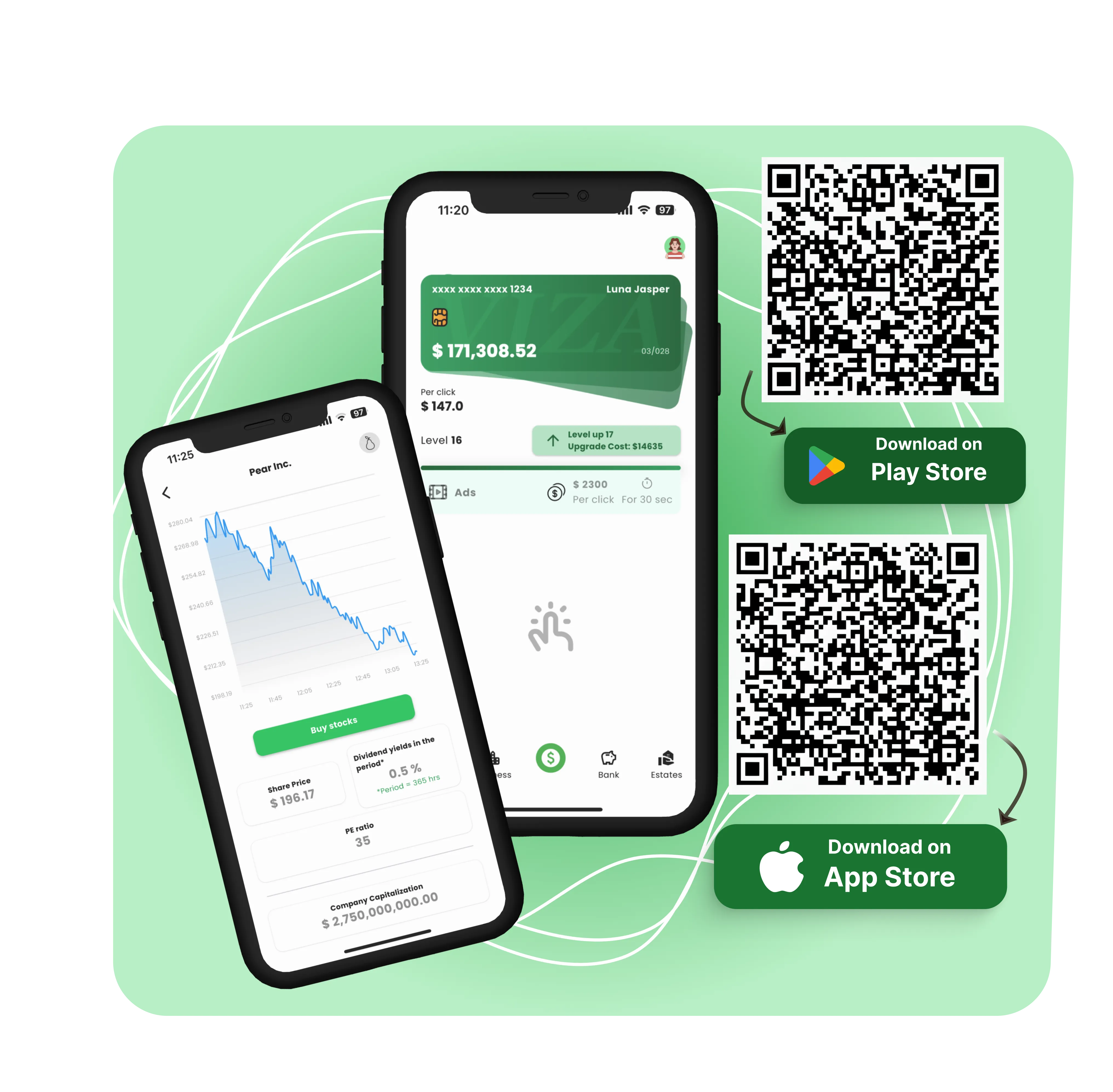
Its investing section includes a Stock Market and a separate Real Estate system. In the Stock Market, players can review company names, dividend rates, and price trends, open a stock's analytics, purchase a chosen number of shares, and view their holdings in the Portfolio. Players can also sell shares to realize virtual gains or reallocate their money.
This system matters because it adds an investment route alongside the game's business-ownership mechanics.
Comparing Stocks Before Buying
Players can browse the available stocks and sort them by dividend yield from high to low or low to high. Selecting a stock opens its analytics, providing additional information to consider before purchasing.
This makes the investment process more deliberate than simply spending money on the first available option.
The player can compare the information displayed by the game and decide which holding fits their current goal. The sorting function helps organize the options, but a higher displayed dividend yield should not automatically be interpreted as the best choice in every situation.
The right decision still depends on the mechanics the game uses and how the player intends to use their virtual capital.
Purchasing Shares and Managing the Portfolio
To purchase a stock, the player opens it, selects Buy Stocks, enters the number of shares, and confirms the purchase. The shares then appear in the Portfolio.
This creates a clear transaction loop: choose an investment, commit virtual money, track the holding, and decide whether to keep or sell it later.
The Portfolio is important because it gives the player a place to manage stock holdings rather than treating every purchase as an isolated action.
Players can also sell shares, allowing the value held in investments to be redirected toward other in-game opportunities.
Dividends and Price Trends
Billionaire Business Empire displays dividend rates and price trends as part of its stock information.
These two indicators represent different aspects of an investment within the game. Dividend rates relate to the income associated with holding shares, while price trends provide information about share-price movement.
Players can examine both when considering a purchase.
It is important, however, not to assume that the game reproduces every mechanism of an actual stock exchange. The game's indicators and outcomes should be interpreted according to its own rules.
How Stocks Fit With Other Income Sources
The stock market is only one part of Billionaire Business Empire's virtual economy.
Players can also purchase businesses that generate daily income and acquire real estate that produces rental income. Banking adds deposits and loans, creating further ways to use virtual money.
These systems give players different options when deciding where to allocate their resources.
For example, upgrading an existing business, purchasing a property, and buying stocks are distinct actions. Each uses capital, but each operates through a different in-game system.
This is the key reason the stock market adds value to the overall simulation: it introduces another investment path that players can consider alongside business ownership and other assets.
Billionaire Business Empire's stock market is a fictional game system. Its displayed prices, dividends, and investment outcomes should not be treated as real financial data or recommendations.
Can Business Games With Stocks Teach Investing Concepts?
Business games with stocks can introduce several investing concepts, particularly when the mechanics make the consequences of a decision visible.
They can help players distinguish between holding an asset and selling it, understand that a share price can change, recognize dividends as a possible source of investment income, and experience the need to allocate limited capital between different opportunities.
They may also introduce portfolio management by allowing players to hold and monitor multiple investments.
However, a game cannot automatically teach someone how to invest responsibly in real financial markets. Real investing involves additional considerations, including company fundamentals, fees, taxes, inflation, liquidity, regulation, market risk, and personal financial circumstances.
A game's simplified market may not account for these factors.
The most useful approach is to treat the game as an introduction to investment concepts, not a guide to selecting real stocks.
Stock Market Games vs. Real Stock Market Simulators
Not every game that includes stocks is designed to teach realistic investing.
Some business simulations use the stock market mainly as a progression mechanic. Their purpose is to give players another way to increase virtual wealth or diversify their in-game activities.
A dedicated stock market simulator may instead emphasize the mechanics of trading, portfolio evaluation, market behavior, or investment practice.
Even then, realism varies between products. Some simulators use historical market data, while others operate with fictional prices or simplified models.
Before treating a game as an educational tool, consider what it actually simulates:
Are stock prices fixed, scripted, or variable?
Do dividends follow clear rules?
Can players lose virtual money?
Does the game explain what affects prices?
Are trading costs or other limitations represented?
Is the goal entertainment, financial education, or both?
The answers help determine whether the game is primarily an empire-building experience with stocks or a more dedicated investing simulator.
What to Look for in a Business Simulation Game With a Stock Market
The quality of the investing experience depends on how the stock market connects with the rest of the game.
A useful stock system should give players a clear reason to compare investments and a meaningful choice about what to do with their holdings.
Look for understandable share information, a clear buying and selling process, useful portfolio tracking, and a consistent explanation of dividends or price movements. It also helps when investments compete with other opportunities for limited resources.
Most importantly, the market should contribute to the overall gameplay rather than feeling like a separate feature that has no effect on progression.
For players who enjoy combining business ownership with virtual investing, a game with both operational and financial systems can provide more variety than one focused exclusively on either activity.
Final Takeaway
Business simulation games with stock markets combine enterprise-building with a second way to allocate capital.
Instead of relying only on purchasing and upgrading businesses, players can buy shares, examine price trends, consider dividends, monitor their portfolios, and decide when to sell or reinvest. These mechanics introduce additional trade-offs and can make progression less dependent on a single income source.
The most important difference is that stock investing creates decisions around financial holdings, while business ownership creates decisions around operating and developing an enterprise. Games that combine the two give players more than one route toward their virtual goals.
Billionaire Business Empire illustrates this hybrid approach through its Stock Market, dividend rates, price trends, analytics, and Portfolio system, alongside its business and real-estate mechanics.
For players, the appeal is the opportunity to explore different investment choices within a connected virtual economy. For anyone interested in financial learning, the useful concepts include asset ownership, dividends, price movements, and capital allocation, with the important reminder that game outcomes are not equivalent to real-world investment results.
Download Billionaire Business Empire | Android | IOS |
FAQs
What are business simulation games with stock markets?
They are business or management games that let players buy, sell, or manage virtual shares alongside other business activities. Depending on the game, the stock market may include price changes, dividends, portfolio tracking, and investment decisions.
How do stock markets change business simulation gameplay?
Stock markets give players another use for their virtual money. Instead of putting all available capital into businesses or upgrades, they can allocate some to shares and manage those holdings according to the game's rules.
Do business games with stocks pay dividends?
Some do. In games with dividend mechanics, players may receive virtual income from eligible shareholdings. The payment rules vary by game, so players should check how dividends are calculated.
What is the difference between a business simulation with stocks and a stock market simulator?
A business simulation with stocks usually combines investing with other activities such as business ownership, upgrades, and expansion. A stock market simulator tends to place greater emphasis on trading, portfolio management, or market behavior, although the level of realism varies.
Does Billionaire Business Empire have a stock market?
Yes. Billionaire Business Empire includes a Stock Market where players can review dividend rates, price trends, and stock analytics, purchase shares, manage them through a Portfolio, and sell holdings.
Can you earn dividends in Billionaire Business Empire?
The game's Stock Market displays dividend rates for available stocks. Players can examine these rates when evaluating shares. The dividends and any associated returns are virtual game mechanics, not real investment income.
Are stocks in business simulation games real investments?
Usually not. In Billionaire Business Empire, the stock market is part of the game's fictional economy. Buying or selling shares in the game does not mean purchasing real securities or earning actual investment returns.
Are stock market simulation games good for learning investing?
They can introduce concepts such as dividends, price changes, portfolio management, and investment trade-offs. However, simplified game mechanics do not replace learning about real-world financial markets, investment risk, fees, taxes, or personal financial planning.


