Business simulation games generally focus on modeling business decisions, financial systems, resources, markets, or management processes. Tycoon games usually focus on building, expanding, and optimizing a business or larger enterprise over time.
The distinction is not absolute. Many games combine both approaches, which is why the terms business simulation, business management game, tycoon game, and sometimes strategy game can describe the same title from different perspectives.
The easiest way to think about the difference is this:
Business simulation emphasizes the business system being managed, while tycoon gameplay emphasizes building and growing the enterprise.
That difference becomes clearer when you look at what the player is actually being asked to do.
What Is a Business Simulation Game?
A business simulation game puts the player in a decision-making environment where business or economic systems are central to the gameplay.
Instead of simply increasing the size of an empire, the player may need to think about revenue, expenses, investments, resources, pricing, risk, financial returns, or competing priorities. The game may simplify real-world economics, but its purpose is often to make the player interact with interconnected business systems.
The important characteristic is decision-making within a simulated business environment.
For example, a game might ask whether available capital should be used to expand an operation, invest in another asset, improve an existing business, or preserve cash for a future opportunity. The entertainment comes from understanding the consequences of those decisions.
Business simulations can therefore range from relatively simple mobile experiences to highly detailed management systems.
What Is a Tycoon Game?
Tycoon games traditionally revolve around the fantasy of becoming an entrepreneur, owner, or industry leader and building an increasingly successful enterprise.
The gameplay loop is usually easy to recognize:
Start small -> earn resources -> expand -> improve operations -> generate more revenue -> expand further.
A tycoon game might place the player in charge of a hotel, transportation company, amusement park, restaurant chain, city, factory, sports organization, or another enterprise.
Expansion is usually a major part of the experience. Players are encouraged to grow their operation, unlock new opportunities, increase efficiency, and eventually create a much larger business than the one they started with.
That does not mean tycoon games lack strategic depth. Many require careful planning. However, their identity is often strongly connected to growth, expansion, optimization, and the feeling of building an empire.
Business Simulation vs. Tycoon Games: Key Differences
There is no official rule that separates the two genres perfectly. Instead, the difference is better understood by looking at their typical design priorities.
Feature | Business Simulation | Tycoon Game |
|---|---|---|
Main emphasis | Business systems and decisions | Building and expanding an enterprise |
Typical objective | Manage a business or economic environment effectively | Grow an increasingly successful empire |
Management | Often central and system-oriented | Usually focused on operational growth |
Expansion | May or may not be central | Usually a major progression element |
Financial decisions | Frequently important | Often important, but commonly tied to expansion |
Progression | Can be based on performance, decisions, or systems | Often based on expansion and unlocking |
Realism | Can range from simplified to highly detailed | Often uses accessible, game-focused systems |
Automation | May be present | Common in many modern tycoon games |
Genre boundaries | Broad | More focused on enterprise-building |
These are tendencies rather than strict rules. A game can emphasize several of these characteristics simultaneously.
Business Systems vs. Empire Building
The biggest difference is often the player's primary relationship with the game.
A business simulation may ask: "How should I manage this system?"
A tycoon game may ask: "How can I build this enterprise into something much larger?"
The two questions overlap, but they create different gameplay priorities.
A simulation-oriented game might make the interaction between several business variables the central challenge. A tycoon game may put more emphasis on expansion, unlocking new operations, increasing production, and watching the enterprise grow.
Management Depth
Business simulation games can place greater emphasis on the details of running a business.
Depending on the game, this might involve allocating resources, analyzing financial performance, responding to changing conditions, managing multiple operations, or balancing competing objectives.
Tycoon games can contain many of these systems as well. The difference is that management is often presented as a means of supporting expansion.
This is why a game can feel like both a management simulation and a tycoon game without fitting neatly into only one category.
Financial Decision-Making
Money is important in both genres, but it can serve different purposes.
In a business simulation, financial decisions may themselves be part of the challenge. Players might have to determine how to allocate limited capital, manage costs, evaluate returns, or balance short-term and long-term objectives.
In a tycoon game, money frequently acts as the engine of expansion. The player earns revenue and uses it to purchase upgrades, open new locations, improve infrastructure, or unlock another stage of growth.
Neither approach is inherently more complex. They simply place the financial system in a different role.
Expansion and Progression
Tycoon games are particularly recognizable for their growth loops.
A small operation becomes a larger operation. New facilities, businesses, territories, products, or services become available. The player's progress is visible through the increasing scale of the enterprise.
Business simulations do not necessarily require this kind of expansion. A simulation can instead focus on optimizing an existing operation or making increasingly sophisticated decisions within a fixed environment.
Modern mobile games frequently combine both approaches, using expansion as the progression layer while incorporating simulation-style financial and management mechanics underneath.
Realism
Realism is another area where the genres are often misunderstood.
A business simulation does not automatically have to be realistic, and a tycoon game does not automatically have to be unrealistic. Both can simplify real-world systems to make them understandable and enjoyable.
The important question is what the game chooses to simulate.
A business simulation might simplify taxation, market behavior, or investment returns while still making those systems meaningful to gameplay. A tycoon game might use fictional businesses but create detailed production, staffing, supply, or pricing systems.
Consequently, realism exists on a spectrum rather than acting as a dividing line between the genres.
Automation and Passive Progression
Automation is especially common in modern tycoon and mobile business games.
Instead of requiring the player to perform every action manually, the game can allow businesses or assets to continue generating resources through an automated or passive system. The player then returns to collect, reinvest, upgrade, and expand.
This creates a different relationship with time. The player is not necessarily managing every transaction; they are deciding what to do with the results of the system.
Business simulations can also use automation, but it is usually one mechanic among many rather than a defining characteristic.
Why Business Simulation and Tycoon Games Overlap
The categories overlap because both genres are built around a similar underlying idea:
Make decisions, manage resources, improve performance, and grow.
Consider a game where you purchase a business, generate income, upgrade it, invest the resulting money elsewhere, and eventually own multiple assets.
You could reasonably describe that experience as a business simulation because it involves managing virtual financial and business systems. You could also describe it as a tycoon game because the player's objective involves building a larger business empire.
Neither description necessarily contradicts the other.
This is why searching for a single dividing line between the genres can be misleading. Genre labels are useful for describing gameplay, but they are not always mutually exclusive technical categories.
Business Simulation vs. Tycoon vs. Strategy Games
The comparison becomes even more interesting when strategy games enter the picture.
Strategy is generally a broader gameplay concept based on meaningful decision-making and planning. A strategy game can involve warfare, politics, civilization building, resources, economics, business, or other systems.
A business simulation can therefore contain strategic gameplay. A tycoon game can also require strategy.
But not every strategy game is a business simulation or tycoon game.
The easiest distinction is to consider the subject of the player's decisions:
Strategy game: planning and decision-making are the central gameplay principles.
Business simulation: those decisions are primarily connected to business or economic systems.
Tycoon game: those decisions are strongly connected to building and expanding an enterprise.
There is considerable overlap between all three.
A business management game could therefore be both a strategy game and a business simulation. If it also centers on growing an increasingly large enterprise, it may reasonably be called a tycoon game as well.
Where Does Billionaire Business Empire Fit?
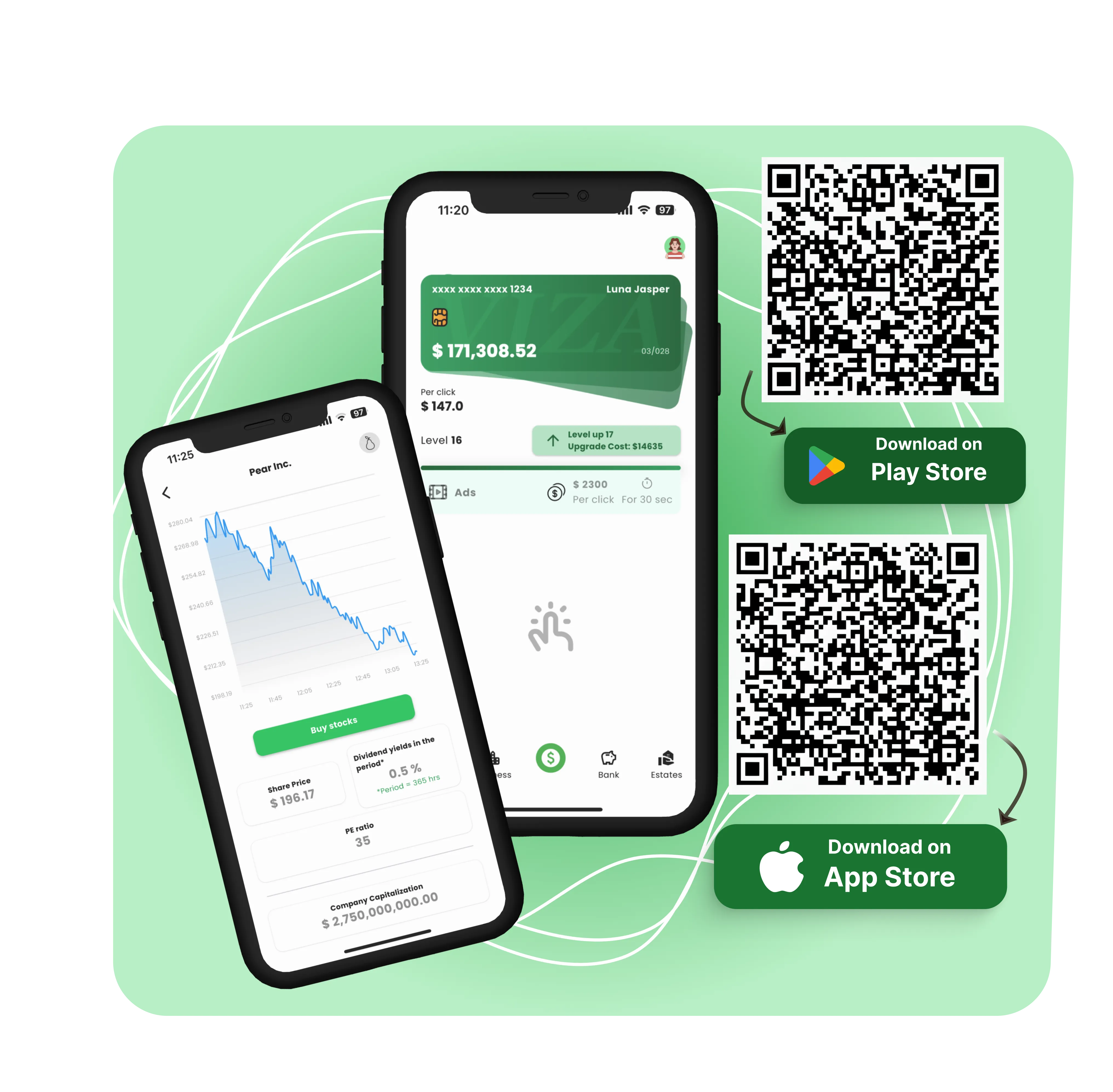
Billionaire Business Empire sits in the overlap between business simulation and tycoon-style gameplay. Its progression is built around accumulating virtual wealth through several connected systems rather than managing only one traditional business.
Players can purchase businesses, monitor their daily income, collect accrued earnings, pay virtual taxes, sell businesses, and upgrade them to increase their income.
The game also extends beyond business ownership. Its Stock Market allows players to examine company names, dividend rates, price trends, and analytics before purchasing shares. Purchased shares are tracked in a Portfolio and can later be sold.
Real estate adds another type of asset, with properties providing rental income that accumulates for collection. Banking introduces deposits and loans, while luxury items provide a different type of progression because they do not generate income but contribute to profile valuation, status, and leaderboard positioning.
That combination makes the game useful for understanding the overlap between the two genres.
From the simulation perspective, players interact with several virtual financial and business systems. From the tycoon perspective, players are building a progressively larger virtual wealth empire.
It is therefore more useful to describe Billionaire Business Empire as a game that combines business-management and wealth-building simulation mechanics with tycoon-style progression than to force it into only one label.
How to Tell What Type of Game You Are Playing
When a game's store description uses several genre labels, look beyond the labels themselves.
Ask what you actually spend your time doing.
If the game primarily asks you to understand interconnected economic or business systems, it has strong simulation characteristics.
If the central satisfaction comes from expanding an operation from a small beginning into a much larger enterprise, it has strong tycoon characteristics.
If you are primarily planning moves, managing resources, and choosing between competing strategic objectives, it may also fall under the broader strategy category.
And if all three are present, the game can legitimately belong to multiple categories.
Look at the Core Gameplay Loop
The gameplay loop is often more revealing than the genre listed on an app store.
A loop centered on analysis -> decision -> consequence -> adjustment tends to feel more simulation-oriented.
A loop centered on earn -> upgrade -> expand -> unlock -> grow tends to feel more tycoon-oriented.
A game that combines both can provide a hybrid experience.
Look at What Progress Means
Progression is another useful clue.
If progress means becoming better at managing an increasingly complex system, the simulation side is likely more prominent. If progress means owning more businesses, expanding operations, unlocking larger opportunities, or increasing the scale of an empire, the tycoon side is likely more prominent.
Many modern mobile business games intentionally combine these progression models.
Are Tycoon Games Business Simulation Games?
Some are, but not all.
A tycoon game can qualify as a business simulation when it meaningfully models business operations, financial decisions, resources, markets, or management systems.
However, the term tycoon is broader in another direction. A tycoon game can focus heavily on expansion and optimization without attempting to simulate business operations in significant detail.
For example, a game may simplify its economic model considerably while still providing a strong enterprise-building experience.
So, tycoon describes a style of gameplay, while business simulation describes a stronger emphasis on simulating business-related systems.
There is overlap, but one term should not automatically be treated as a synonym for the other.
Are Business Simulation Games More Realistic Than Tycoon Games?
Not necessarily.
Realism depends on the individual game, not simply its genre label. Some business simulations use simplified rules designed for accessibility. Some tycoon games can have surprisingly detailed management systems.
A better question is how much complexity the game gives to its business model and how closely those systems resemble real-world relationships.
A game can be highly strategic without being highly realistic, and it can be realistic in some areas while simplifying others.
Which Genre Is Better for Beginners?
There is no universal answer because difficulty depends on the individual game's systems and interface.
Players who enjoy straightforward growth and visible expansion may find a tycoon-style progression loop easier to understand. Players who enjoy analyzing systems and making decisions around business or financial mechanics may prefer a simulation-focused experience.
Hybrid games can provide both: a clear growth objective while gradually introducing more management and financial decisions.
Why Are Business Simulation and Tycoon Games Popular on Mobile?
Mobile devices are well suited to games built around short decision cycles and progressive growth.
A player can check an operation, collect accumulated income, make an investment, purchase an upgrade, or review progress without needing a long uninterrupted session.
This works particularly well for business and tycoon games because progression can be divided into manageable decisions.
The format also allows a game to start with simple mechanics and gradually introduce additional systems as the player's virtual operation becomes more complex.
The Difference Comes Down to Emphasis
The simplest way to understand business simulation vs. tycoon games is not to look for a rigid genre boundary.
Instead, look at the game's primary emphasis.
Business simulation games emphasize the simulation and management of business-related systems. Tycoon games emphasize building, expanding, and optimizing an enterprise.
A game can strongly emphasize one side or combine both.
That overlap is particularly common in modern mobile games, where business ownership, investments, upgrades, passive income, and long-term empire building can exist within one progression system.
Billionaire Business Empire is an example of this hybrid approach: its business, investment, real-estate, banking, and wealth-progression systems create a business-management experience, while its larger objective of building virtual wealth gives it clear tycoon-style characteristics.
Understanding that distinction makes it easier to choose games based on how you want to play, rather than relying only on genre labels.
FAQs
What is the main difference between a business simulation and a tycoon game?
A business simulation generally emphasizes managing and interacting with business or economic systems, while a tycoon game generally emphasizes building, expanding, and optimizing an enterprise. Many games combine both.
Is a tycoon game a business simulation?
Sometimes. A tycoon game can also be a business simulation when it includes meaningful business, financial, economic, or management systems. However, the two terms are not exact synonyms.
Are business simulation games and tycoon games the same?
No. They overlap but describe different aspects of gameplay. Business simulation focuses more on the systems being simulated, while tycoon gameplay typically focuses more on enterprise growth and expansion.
What is the difference between a business simulator and a tycoon game?
A business simulator generally aims to let players interact with simulated business processes or decisions. A tycoon game usually gives players the goal of building and expanding a successful enterprise. A single game can do both.
Is Billionaire Business Empire a business simulation or a tycoon game?
Billionaire Business Empire combines characteristics of both. Its businesses, stock market, real estate, and banking systems provide business and financial simulation mechanics, while its long-term wealth-building progression gives it a tycoon-style experience.
Are tycoon games strategy games?
Many tycoon games require strategy because players must decide how to use limited resources, when to expand, and which improvements to prioritize. However, strategy is a broader gameplay concept, so not every strategy game is a tycoon game.


