A business simulation game is a type of video game that allows players to manage businesses, make financial decisions, allocate resources, and experience the consequences of strategic choices in a virtual environment.
Instead of controlling only a character or completing a fixed sequence of missions, players usually manage systems that develop over time. They may start with limited capital, purchase a business, invest in assets, expand operations, manage income, respond to changing conditions, and work toward a larger financial or business goal.
Some business simulation games focus on running a company. Others concentrate on investing, real estate, production, retail, city development, entrepreneurship, or idle income.
The common element is that progress depends on decisions about resources, growth, and management.
Business simulation games are popular because they combine entertainment with systems that resemble real-world business concepts. Players can explore ideas such as profit, risk, opportunity cost, reinvestment, diversification, and long-term planning without facing the financial consequences of making those decisions in real life.
What Is a Business Simulation Game?
A business simulation game recreates selected parts of business activity through interactive game mechanics.
The player may act as a company owner, entrepreneur, investor, manager, property developer, or business empire builder. The game then provides a virtual economy or progression system in which the player must decide how to use limited resources.
These resources may include:
Virtual money
Businesses
Production capacity
Employees or staff
Inventory
Property
Investments
Time
Energy
Research points
In-game currencies
The objective varies from game to game. A player may need to grow a company, earn a target amount of money, dominate a market, build a profitable portfolio, complete business challenges, or unlock a larger empire.
A business simulation game does not need to reproduce every detail of a real company. Most games simplify reality so that the systems remain understandable and enjoyable. The important part is that the game gives players meaningful choices and connects those choices to outcomes.
Simple Definition
A business simulation game is a game in which players manage virtual business or economic systems and make decisions that influence growth, income, resources, and progress.
How Do Business Simulation Games Work?
Although every game has its own rules, most business simulation games follow a similar cycle.
Start with Limited Resources
Players usually begin with a small amount of money, one business, a basic operation, or a restricted set of available options. Starting with limited resources creates the central challenge. The player cannot purchase everything immediately and must decide what deserves attention first.
Make a Business Decision
The player chooses how to use available resources.
That decision could involve:
Buying a business
Hiring staff
Purchasing equipment
Investing in a new product
Expanding into another market
Buying property
Purchasing stocks
Upgrading an existing operation
Saving money for a larger opportunity
The game turns these choices into an interactive management problem.
Generate Income or Progress
The decision produces a result. A business may generate revenue, a property may produce rental income, a product may sell, or an investment may increase in value. Some games provide immediate rewards. Others require time before the player receives a return.
Reinvest Resources
Successful players usually use part of their income to improve future performance. For example, a player might use profits to upgrade a business instead of spending everything on cosmetic items. Reinvestment can increase earning capacity and make later decisions more valuable.
Expand the Operation
As the player progresses, new businesses, markets, locations, assets, or features may become available. The game gradually changes from a small operation into a larger management challenge.
Repeat and Optimize
The player continues reviewing results and adjusting the strategy.
This creates the central loop of many business simulation games:
Earn -> decide -> invest -> grow -> review -> improve.
Main Types of Business Simulation Games
The business simulation genre includes several different subcategories. Two games may both be called business simulators while offering very different experiences. Understanding these types makes it easier to choose a game that matches your interests.
Business Management Simulation Games
Business management simulations focus on operating a company and making decisions that influence its performance.
Depending on the game, players may manage:
Employees
Production
Inventory
Pricing
Customers
Suppliers
Marketing
Business locations
Operating costs
Expansion
Company finances
The challenge is not simply to earn money. Players must understand how different parts of the business affect one another. For example, increasing production may create more products to sell, but it may also increase costs.
Expanding into a new location may increase revenue, but it can require additional investment. Hiring more employees may improve capacity while also increasing operating expenses. These games are suitable for players who enjoy making connected decisions rather than upgrading one number at a time.
What makes management simulations different?
The player is usually responsible for more than one part of the business. Income, expenses, operations, and growth may all need to be considered together. This makes business management simulations especially useful for exploring the relationship between decisions and consequences.
Business Tycoon Games
Business tycoon games focus on building and expanding a large commercial empire.
The player may start with a small store, restaurant, factory, hotel, transport company, or another business. As progress continues, the player unlocks more locations, products, services, and upgrades.
Tycoon games commonly emphasize:
Expansion
Unlocking new businesses
Increasing revenue
Building a large empire
Improving efficiency
Reaching higher levels
Managing multiple locations
The term "tycoon" usually highlights the fantasy of becoming a powerful business owner. Some tycoon games are highly detailed management simulations. Others are more casual and focus on rapid progression, upgrades, and visual growth.
Idle Business Simulation Games
Idle business games are designed around income or progress that continues with limited active input. The player may purchase businesses, hire managers, improve earning rates, and return later to collect accumulated rewards or make new decisions.
Idle mechanics can make business simulation games accessible to mobile players because they do not require constant attention.
A typical idle business loop may include:
Start a small income source.
Upgrade its earning rate.
Unlock automation.
Add another business.
Return later to collect progress.
Reinvest earnings.
Continue expanding.
Idle games generally place more emphasis on progression and automation than on detailed daily management. However, not every idle game is strategically simple. Some include decisions about upgrades, timing, resource allocation, investments, and long-term priorities.
Investment and Financial Simulation Games
Investment simulations focus on financial decisions rather than operating a traditional business.
Players may manage:
Stocks
Bonds
Funds
Portfolios
Dividends
Interest
Currency
Market prices
Risk
Asset allocation
The goal may be to grow wealth, identify opportunities, manage risk, or understand how different assets behave.
These games can help players become familiar with financial vocabulary and basic concepts. However, virtual markets are simplified systems, so players should not treat game results as a reliable prediction of real financial markets.
A financial simulation can be useful for understanding why investors consider factors such as:
Potential return
Risk
Diversification
Time horizon
Liquidity
Market movement
Real Estate Simulation Games
Real estate simulation games focus on buying, developing, managing, or selling property. Players may purchase residential buildings, commercial locations, hotels, offices, or other properties. The game may then calculate rental income, property value, maintenance costs, or development opportunities.
Real estate mechanics often introduce a different form of progression. Instead of relying only on active business operations, players may build a portfolio of assets that produces recurring income.
Common decisions include:
Which property to buy
Whether to prioritize price or income
When to upgrade
Whether to sell an asset
How to balance multiple properties
Whether to focus on short-term or long-term returns
Real estate systems are often combined with business or investment mechanics in larger empire-building games.
Economic Simulation Games
Economic simulations model broader systems such as supply, demand, production, trade, prices, resources, and markets. The player may control a company, industry, region, or entire economy.
These games can involve:
Producing goods
Buying raw materials
Managing supply chains
Setting prices
Trading with other players
Responding to demand
Managing shortages
Competing in a market
Economic simulations tend to be more system-focused than simple business progression games. A player's results may depend on several connected variables rather than a single upgrade path.
Entrepreneurship and Startup Simulation Games
Entrepreneurship simulations focus on starting and growing a company. Players may need to choose a business idea, develop products, attract customers, manage funding, hire employees, and compete with other companies. These games often emphasize the uncertainty of building something from the beginning.
Typical gameplay questions include:
What should the company sell?
Which market should it enter?
How much money should be invested?
When should the business expand?
Should profits be reinvested?
How should the company respond to competition?
Entrepreneurship games are especially appealing to players who enjoy the idea of building a company from nothing.
Industry-Specific Business Simulations
Some business simulation games focus on one particular industry.
Examples include simulations based on:
Restaurants
Hotels
Theme parks
Retail stores
Transport
Airports
Factories
Sports clubs
Hospitals
Media companies
Game development
Agriculture
These games can offer more detail within their chosen industry because the mechanics are designed around a specific business environment.
A restaurant simulation may focus on menus, customers, staff, and kitchen operations. A game development simulation may focus on products, technology, reviews, and release timing.
What Are the Main Mechanics in Business Simulation Games?
The mechanics are the systems that make a business simulation playable. They determine what the player can do and how the game responds.
Money and Virtual Currency
Money is usually the central resource in a business simulation.
Players may use virtual currency to:
Buy businesses
Purchase equipment
Upgrade operations
Invest in assets
Hire staff
Unlock features
Expand into new areas
The important question is not only how much money the player has, but how effectively that money is being used. A player with a large balance may still progress slowly if the money is not allocated well.
Revenue and Profit
Revenue is the money generated by a business or activity. Profit is what remains after relevant costs are deducted. Some games simplify these concepts, while others separate income and expenses more clearly.
Understanding the difference is useful because a business that produces high revenue is not necessarily the most profitable business. Costs, upgrades, taxes, maintenance, and other expenses may influence the final result.
Upgrades
Upgrades improve the performance of a business, asset, or character.
An upgrade may:
Increase income
Reduce costs
Improve production
Increase speed
Unlock a new feature
Improve capacity
Increase the value of an asset
Good upgrade systems create a decision about timing. Players must consider whether an upgrade will produce enough additional value to justify its cost.
Expansion
Expansion allows players to move from a small operation into a larger business empire.
This may involve:
Purchasing another business
Opening a new location
Entering a new industry
Unlocking a new market
Buying additional property
Adding another source of income
Expansion usually increases potential earnings, but it may also create more management responsibilities.
Automation and Passive Income
Automation reduces the amount of direct action required from the player. For example, a business may continue producing income after a manager is hired or an automated system is unlocked.
Passive income is attractive because it allows players to make progress between active sessions. It also changes the strategy: instead of focusing only on immediate rewards, players can build systems that generate value over time.
Investment and Asset Management
Some business simulations allow players to own several types of assets.
These may include:
Businesses
Stocks
Property
Bank deposits
Luxury items
Other virtual assets
Each asset may have a different purpose. Some generate income, some may change in value, and others may contribute mainly to net worth or status.
Understanding the role of each asset is important because not every purchase improves income.
Risk and Uncertainty
More advanced business simulations include risk.
Risk may appear through:
Changing prices
Market conditions
Competition
Operating costs
Limited resources
Failed investments
Unexpected events
Customer demand
Risk makes decisions less predictable and encourages players to avoid relying on only one strategy.
Progression and Unlocks
Progression systems give players a reason to continue playing.
A game may unlock:
New businesses
New investment options
Higher earning capacity
New locations
Additional features
Better upgrades
More complex management systems
Progression is usually connected to money, experience, player level, achievements, or other milestones.
Leaderboards and Social Features
Some business simulation games include social systems such as:
Leaderboards
Friends
Player-to-player transfers
Competitions
Shared markets
Cooperative activities
Rankings
These features add a social objective beyond personal progress. For example, a player may try to improve their net worth, reach a higher leaderboard position, or help other players through an in-game financial system.
What Is the Difference Between a Business Simulation and a Regular Strategy Game?
Business simulation games and strategy games overlap, but they usually emphasize different systems. A traditional strategy game may focus on combat, territory, diplomacy, armies, or tactical positioning.
A business simulation game generally focuses on economic decisions such as:
Managing money
Building businesses
Allocating resources
Increasing profit
Expanding operations
Investing in assets
Managing risk
However, business simulations are still strategy games in a broader sense because players must plan, prioritize, and respond to consequences.
The difference is mainly the subject of the strategy.
A military strategy game asks: How should I use my army and resources to defeat an opponent?
A business simulation asks: How should I use my money and resources to build a successful business?
What Is the Difference Between a Business Simulation and a Tycoon Game?
The terms are often used interchangeably, but they usually describe different emphases.
A business simulation focuses on simulating business or economic systems. It may include management, finances, operations, markets, investment, or resource allocation.
A tycoon game focuses on the experience of building and expanding a large business empire.
A game can be both. Many modern mobile games combine simulation mechanics with tycoon-style progression.
For example, a game may let players buy businesses, upgrade income, unlock new industries, and build a large empire. That game may be described as both a business simulation and a tycoon game.
The most useful way to distinguish them is to look at the actual mechanics rather than relying only on the label.
What Is the Difference Between a Business Simulation and an Idle Game?
An idle game is defined mainly by how progress happens. In an idle game, income or progress may continue with limited active input. The player returns periodically to collect rewards, purchase upgrades, and improve automation.
A business simulation is defined mainly by what is being simulated: businesses, markets, finances, management, or economic systems.
Therefore, a game can be:
A business simulation without idle mechanics
An idle game without business mechanics
Both a business simulation and an idle game
Billionaire Business Empire, for example, combines business and wealth-building systems with idle-style progression. Players can build income through businesses and use other systems such as stocks, real estate, banking, and luxury items as part of their virtual empire.
What Makes a Business Simulation Game Realistic?
Realism does not necessarily mean that a game must include every detail of real business. A simulation can feel realistic when its systems behave in a logical and consistent way.
Important factors include:
Connected systems: Business decisions should influence more than one result. For example, expansion may increase revenue but also require additional spending.
Meaningful trade-offs: Players should have to choose between competing priorities. Spending money on one opportunity may delay another.
Clear consequences: The game should show how decisions affect income, growth, costs, or progress.
Limited resources: A player should not be able to purchase everything immediately. Scarcity creates strategy.
Long-term planning: The best decision is not always the one that provides the fastest immediate reward.
Understandable rules: A realistic system should still be clear enough for players to understand why something happened.
A game can be simplified and still provide valuable strategic thinking. Realism is not only about complexity; it is also about whether the game creates believable relationships between decisions and outcomes.
Can Business Simulation Games Teach Real-World Business Concepts?
Business simulation games can introduce players to several real-world concepts.
Resource allocation: Players must decide where to spend limited money, time, or other resources.
Opportunity cost: Choosing one investment often means giving up another opportunity.
Reinvestment: Using profits to improve future earning capacity is a common feature of business games.
Risk and return: Some investments offer higher potential rewards but involve greater uncertainty.
Diversification: Owning different types of assets may reduce dependence on one income source within the game.
Cash flow: Players may need to manage the timing of income and expenses.
Scaling: A small business may become more profitable as the player increases capacity or expands operations.
Long-term planning: Players often need to choose between immediate rewards and future growth.
However, a business simulation is still a simplified model. It cannot reproduce the full complexity of taxes, regulation, employees, customers, legal obligations, competition, or financial markets.
The best way to use these games is as an introduction to concepts, not as a replacement for real-world education or professional advice.
How Billionaire Business Empire Fits Into the Business Simulation Genre
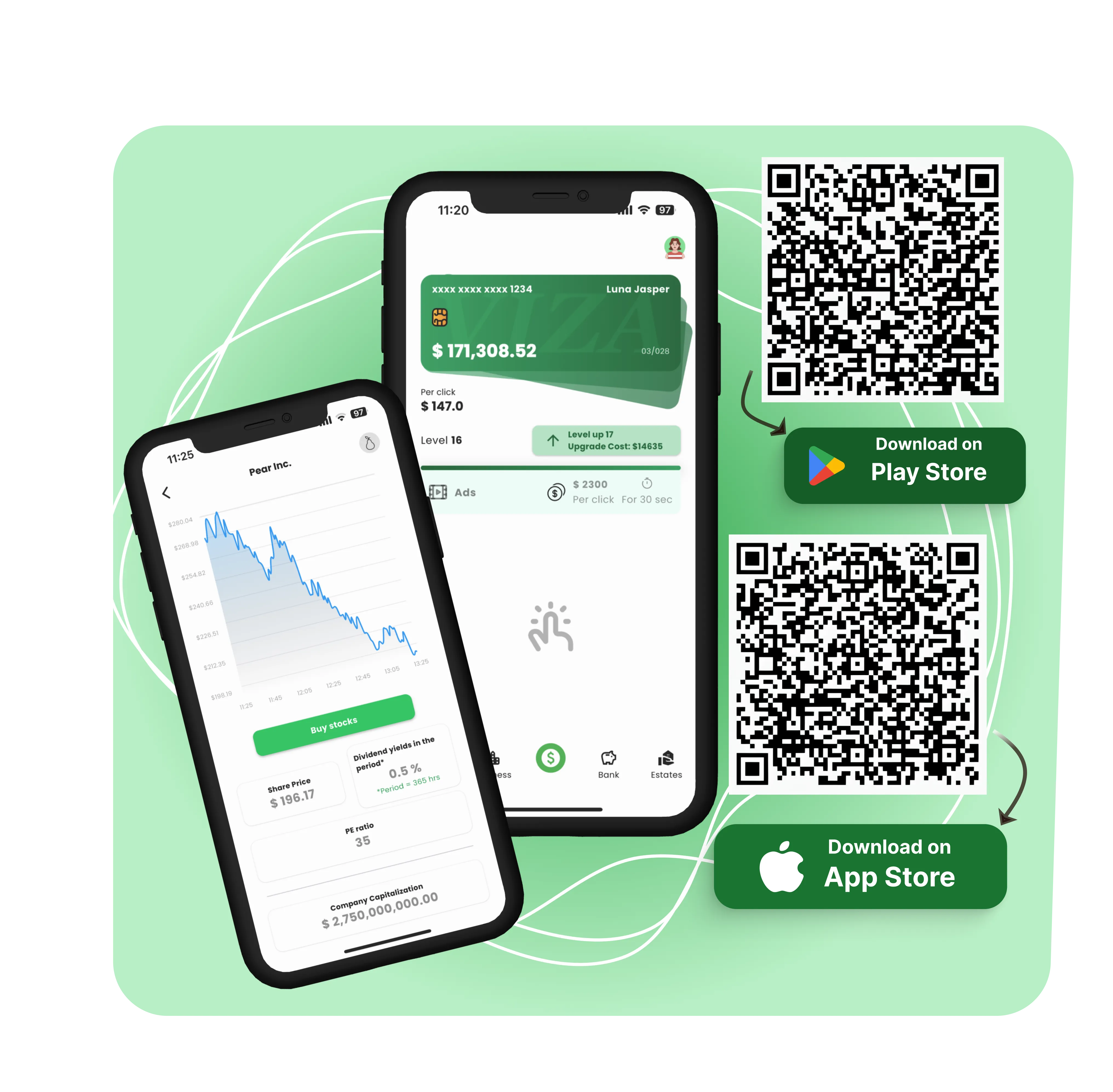
Billionaire Business Empire (Android / IOS) is a mobile business and wealth-building simulation that combines several systems within one virtual economy. Instead of focusing on only one industry, the game allows players to explore different ways of building virtual wealth.
Its gameplay includes:
Tap to Earn
Business ownership
Business upgrades
Daily business income
Stock Market investing
Dividends and price trends
Real estate
Rental income
Banking features
Loans and deposits
Luxury items
Gems
Player rankings
Social money transfers
This combination places the game across several parts of the business simulation genre. Its business system represents company ownership and income generation.
The Stock Market introduces investment decisions. Real estate adds another asset category, while banking introduces deposits, interest, and loans. Luxury items contribute to virtual net worth and status rather than functioning as ordinary income-producing assets.
That variety is useful for players who want to explore more than one business concept in the same mobile game.
Is Billionaire Business Empire a business simulation or an idle game?
It can be understood as both. It includes business and financial simulation systems, while also using idle-style progression and income-building mechanics.
The exact experience depends on how the player chooses to engage. Some players may focus on active tapping and upgrades, while others may spend more time managing businesses, investments, property, and long-term wealth.
Is the money in Billionaire Business Empire real?
No. The game's businesses, stocks, properties, banking systems, and other financial features are part of a virtual simulation. Players are making in-game decisions with virtual resources. The game should not be treated as a real investment platform or a way to earn guaranteed real-world income.
How to Choose the Right Business Simulation Game
The best business simulation game depends on the type of experience you want.
Choose a management simulation if you enjoy:
Running operations
Managing staff
Balancing income and expenses
Making detailed business decisions
Improving efficiency
Choose a tycoon game if you enjoy:
Building a large empire
Unlocking new businesses
Expanding quickly
Watching numbers and assets grow
Reaching large progression milestones
Choose an idle business game if you enjoy:
Short play sessions
Automated income
Incremental upgrades
Returning to collect progress
Long-term growth with limited active input
Choose an investment simulation if you enjoy:
Stocks
Dividends
Portfolio decisions
Market movement
Risk and return
Choose a real estate simulation if you enjoy:
Buying property
Rental income
Asset ownership
Portfolio building
Long-term investment decisions
Choose an entrepreneurship simulation if you enjoy:
Starting from nothing
Building a company
Creating products
Competing in a market
Making startup decisions
What Should Beginners Look for in a Business Simulation Game?
A beginner-friendly business simulation should explain its systems clearly and introduce complexity gradually.
Useful features include:
A clear tutorial
Simple early objectives
Understandable income and costs
Visible upgrade benefits
A manageable number of resources
Explanations for unfamiliar terms
A progression system that introduces features over time
Beginners should also look for games that make it easy to understand why a decision worked or failed. If the game gives a reward without explaining the reason, it may be entertaining but less useful for learning business concepts.
Common Mistakes Players Make in Business Simulation Games
Even simple business simulations can become more difficult when players use resources without a clear plan.
Spending everything immediately: Keeping no available money can prevent players from taking advantage of a better opportunity later.
Chasing income without considering cost: A business with high revenue may not be the most efficient option if its costs are also high.
Upgrading without a goal: Upgrades are more useful when they support a clear objective, such as increasing income or unlocking a new feature.
Ignoring different asset types: Some assets generate income, while others mainly contribute to value, status, or progression.
Expanding too quickly: More businesses can create more potential income, but expansion may also require more resources and attention.
Focusing only on short-term rewards: Immediate income is useful, but long-term growth often depends on building a stronger system.
Treating the game as a real financial market: Virtual stocks, property, and banking systems are simplified game mechanics. They should not be used as direct guides to real-world investing.
Are Business Simulation Games Good for Learning?
They can be useful for learning basic concepts through practice.
A player may understand reinvestment more clearly after seeing how an upgrade increases future income. The idea of opportunity cost becomes easier to recognize when spending money on one asset prevents the purchase of another. Risk becomes more understandable when a decision produces an uncertain result.
The learning value depends on the game design and the player's approach.
A game that includes clear choices, connected systems, and meaningful consequences can encourage strategic thinking. A game that only rewards repeated tapping may provide less opportunity for deeper decision-making.
Business simulation games are best viewed as interactive introductions to business concepts, not complete business courses.
Conclusion
A business simulation game turns business and economic decision-making into an interactive experience.
Depending on the title, players may run companies, manage staff, invest in stocks, purchase property, build an empire, operate a production chain, or grow income through idle progression. Some games prioritize detailed management, while others focus on expansion, accessibility, or long-term wealth building.
The genre is broad, but its central idea remains consistent: players make decisions with limited resources and see how those decisions influence progress.
For players who want to explore several business and wealth-building systems in one mobile game, Billionaire Business Empire offers a combination of businesses, stocks, real estate, banking, luxury items, and virtual net-worth progression.
Whether you prefer detailed management or relaxed idle growth, the best business simulation game is the one that gives you the type of decisions you most enjoy making.
Frequently Asked Questions
What is a business simulation game?
A business simulation game is a game in which players manage virtual businesses, money, resources, investments, or economic systems. The player's decisions influence income, growth, assets, and overall progress.
What are the different types of business simulation games?
Common types include business management simulations, business tycoon games, idle business games, investment simulations, real estate games, economic simulations, entrepreneurship games, and industry-specific management games.
What is the difference between a business simulation and a tycoon game?
Business simulations focus on modeling business or economic systems, while tycoon games emphasize building and expanding a large empire. Many games combine both approaches.
Are idle games business simulation games?
Some are. An idle game is defined by its progression system, while a business simulation is defined by the business or economic systems it represents. A game can be both idle and business-focused.
Can business simulation games teach financial literacy?
They can introduce concepts such as income, expenses, reinvestment, risk, opportunity cost, diversification, and asset management. However, virtual game systems are simplified and should not replace real financial education.
What is a good business simulation game for mobile?
The right choice depends on the player's interests. Some mobile games focus on detailed management, while others emphasize idle income, investing, real estate, or empire-building. Billionaire Business Empire is designed for players who want to combine business ownership, stocks, real estate, banking, and virtual wealth progression in one mobile experience.
Is Billionaire Business Empire a business simulation game?
Yes. Billionaire Business Empire combines business ownership, virtual income, investing, real estate, banking, luxury assets, and wealth progression. It also includes idle-style mechanics that allow players to build and manage income over time.
Can I earn real money from a business simulation game?
Business simulation games generally use virtual currencies and fictional economies. In-game earnings should not be confused with real-world income. Billionaire Business Empire is a virtual simulation and is not a real-money investment platform.


