A mobile business simulation game lets players build, manage, invest, expand, and make financial decisions inside a simulated economy. The basic goal may sound simple: make more money, but the genre covers a surprisingly wide range of experiences.
One game may ask you to repeatedly tap and reinvest profits into an expanding idle empire. Another may focus on running a restaurant, managing employees, trading stocks, buying property, building a startup, or responding to changing market conditions.
Some are designed for a few minutes of play at a time. Others expect you to think carefully about capital allocation and long-term strategy.
That variety is precisely why the genre can be confusing for new players. A game described as a business game might actually be a simple clicker. A tycoon game may focus on constructing and expanding locations.
A deeper business simulator can combine several systems- companies, investments, property, banking, and a changing economy- into one larger financial sandbox.
This guide explains what defines the genre, how different types of mobile business games work, what separates strategy from simple progression, and what players should look for when choosing a game.
What Is a Mobile Business Simulation Game?
A mobile business simulation game is built around the experience of making decisions that affect the growth of a virtual business, company, portfolio, or economic empire.
Unlike many mobile games, success is usually not determined primarily by reaction speed or combat skill. Progress comes from decisions such as where to invest, what to upgrade, when to expand, how to manage limited resources, and whether to pursue short-term gains or long-term growth.
At its simplest, the genre follows a familiar cycle:
'Earn money' to 'make a decision' to 'improve earning capacity' to 'earn more money' to 'face larger decisions'
The complexity comes from what happens between those steps.
A straightforward idle business game may allow players to reinvest profits into upgrades that automatically increase income. A more advanced mobile business simulation game can introduce multiple forms of wealth and force players to decide how those systems should work together.
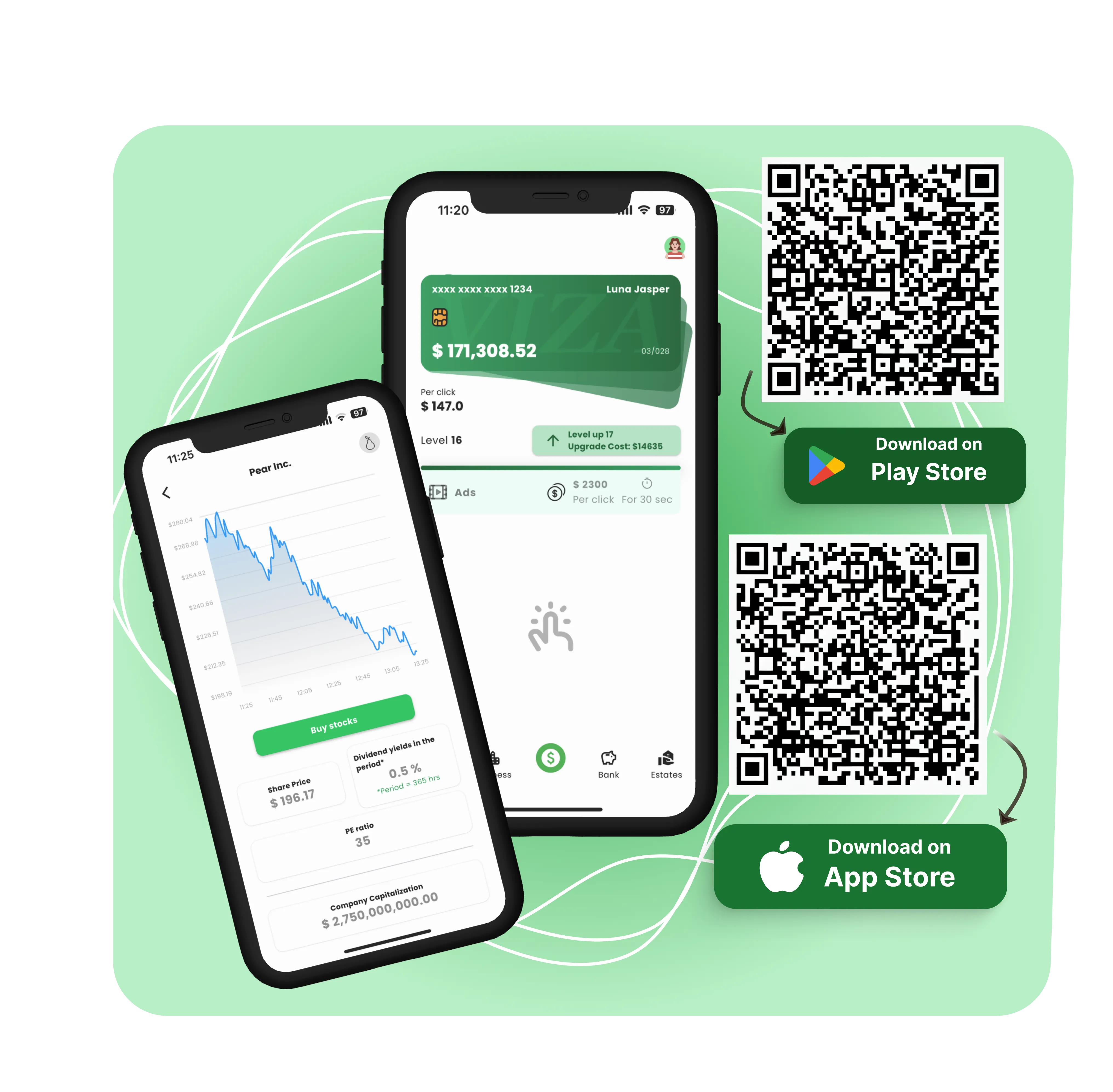
For example, the official Billionaire Business Empire website presents Stocks, Business, Real Estate, Loans, Assets, and Portfolio management as connected parts of its business simulator. Its existing gameplay guide also describes a progression system involving tapping to earn, businesses, stock investing, real estate, banking, luxury items, gems, and social features.
That illustrates an important point about the genre: a business simulation is not defined by the presence of money alone. It is defined by what players are asked to do with that money.
Why Business Simulation Games Work So Well on Mobile
Business simulations have existed long before smartphones, but mobile devices changed how the genre could be played.
Traditional simulation games often demand long sessions, large interfaces, and constant attention. Mobile games have had to adapt those ideas to smaller screens and shorter play sessions. The result is a genre that can accommodate both quick check-ins and longer strategic sessions.
A player might spend two minutes collecting earnings and reviewing an investment, then return later when enough capital has accumulated for a larger decision. That rhythm works naturally on a phone.
Mobile business games also benefit from asynchronous progression. Instead of requiring every minute of progress to happen while the screen is open, many titles use idle or offline systems that allow an established business to continue generating value between sessions.
This is why idle mechanics became so closely associated with the mobile business genre. They solve a practical problem: a business empire should feel as though it continues operating even when the player has other things to do.
The best games, however, do not confuse less active time with less strategy. They use idle progression to give players more meaningful decisions when they return.
The Major Types of Mobile Business Simulation Games
The term business game covers several distinct styles. Understanding those differences makes it easier to find a game that actually matches the experience you want.
Idle and Incremental Business Games
Idle business games are built around growth over time.
Players start with a relatively small source of income, then reinvest profits to make that source more productive. As earnings increase, larger upgrades, new businesses, and additional systems become available.
The satisfaction comes from watching a small operation develop into something much larger.
These games are usually accessible because the core loop is easy to understand. The strategic question is not necessarily How do I earn money at all? It is more often: where should my next investment go?
The weakness of a poorly designed idle game is that it can become repetitive. If every decision has the same answer- buy the next upgrade whenever possible- then the business theme becomes little more than decoration.
A stronger idle game introduces trade-offs. Players may have to choose between improving an existing business, diversifying into another industry, investing in a financial asset, or saving for a larger opportunity.
Billionaire Business Empire belongs to the broader idle business category but combines that progression with multiple investment systems. The game's official content describes it as allowing players to build wealth through businesses, stocks, real estate, banking, and other financial features rather than relying on a single income stream.
Tycoon and Empire-Building Games
Tycoon games focus more heavily on ownership and expansion.
Instead of simply increasing a number, players build an increasingly large operation. Depending on the game, that might mean running a hotel, transport company, factory, theme park, restaurant chain, or an entire collection of businesses.
The appeal is partly visual and partly strategic. Players enjoy seeing evidence of expansion: more locations, larger operations, additional industries, or a growing portfolio.
The important distinction is that not every tycoon game is a deep economic simulation. Some focus mainly on building and upgrading, while others require players to manage costs, demand, competition, and resources.
If you enjoy the feeling of starting small and eventually owning a vast empire, this is usually the most natural branch of the genre.
Business Management Games
Business management games place more emphasis on operating decisions.
The player may need to think about employees, pricing, production, customer demand, departments, efficiency, or other day-to-day aspects of running an organization.
These games tend to feel closer to traditional management simulations because growth is not always automatic. A poor decision can create a genuine problem, while good management can improve performance.
This style appeals to players who want to feel like an operator rather than simply an investor.
There is also a trade-off. More management systems can create greater depth, but they can make a mobile game harder to learn. Developers therefore have to decide how much complexity can fit comfortably into a touch-based interface.
Investment and Financial Simulation Games
Some business games move away from operating a company and focus instead on capital.
Players may buy and sell stocks, invest in property, manage loans, build portfolios, or react to market changes.
These games appeal to a different kind of strategist. The central challenge is less about running a business directly and more about deciding where money should go.
A strong financial simulation needs meaningful differences between asset types. If every investment produces the same predictable result, there is little reason for players to think strategically.
Billionaire Business Empire combines this approach with business ownership. Its official site highlights stocks, real estate, loans, assets, and portfolio features, while the game's existing guide explains that players can move from earning money to managing several forms of virtual wealth.
This hybrid approach is increasingly important within the mobile genre because it gives players more than one way to progress.
Industry-Specific Business Games
Some of the best business simulations deliberately stay narrow.
A restaurant simulator can concentrate on food service. A property game can focus entirely on buying, renovating, and managing real estate. A transport game can make routes and logistics the main challenge.
This focus allows developers to explore one industry in greater detail.
The trade-off is variety. Players who want to manage an entire financial empire may eventually feel constrained by a game built around only one activity.
That does not make focused business games inferior. It simply means they answer a different player fantasy.
The question is whether you want to become excellent at one type of business or build a diversified empire across several systems.
What Actually Makes a Good Mobile Business Game?
The word simulation is used very loosely in mobile gaming. A game does not become a meaningful business simulator simply because it displays money, upgrades, and a shop.
The quality of the genre depends on the decisions it creates.
Meaningful Choices
A good mobile business game gives players options that matter.
If you always have enough money to buy everything, there is no real allocation problem. If every upgrade is obviously better than every alternative, there is little strategy.
Interesting business games create situations where players have to choose.
Should you reinvest profits now or save for a larger opportunity?
Should you improve an existing business or diversify?
Should you prioritize a stable source of income or take a greater risk?
Those questions give the money system a purpose.
A Clear Progression Loop
Players should understand why they are earning money and what additional wealth allows them to do.
The strongest progression loops expand naturally.
Early decisions are relatively simple because players have limited capital and few systems to manage. Later, the game introduces more options and makes financial decisions increasingly interconnected.
Billionaire Business Empire's existing content follows this kind of progression: players begin by tapping to earn, then move into businesses and eventually manage investments including stocks, real estate, and banking.
A progression system like this works because it gives new players a starting point without permanently limiting the game's strategic ceiling.
Different Ways to Build Wealth
The most interesting empire games usually avoid making every source of income identical.
Businesses should feel different from property. Property should serve a different purpose from stocks. Loans should introduce different considerations from cash-based investing.
The goal is not to overwhelm the player with menus. The goal is to give each system a role.
Billionaire Business Empire's official website explicitly presents its systems as a broader portfolio of Businesses, Stocks, Real Estate, Loans, and Assets.
When these systems are connected effectively, players can develop their own approach rather than following one compulsory path.
Progress That Respects the Player's Time
Mobile games are often played in fragments.
A good business simulation should recognize that. It should allow meaningful progress during a short session without requiring players to remain online for hours.
Idle and offline systems are useful here, but they need balance.
If everything happens automatically, active play loses its purpose. If nothing happens while the player is away, the game may demand more constant attention than many mobile players want.
The ideal middle ground is simple:
Active play improves the empire. Idle progression rewards the empire you have already built.
This principle is especially relevant to Billionaire Business Empire, whose gameplay combines idle earning with active decisions across businesses and financial systems.
The Difference Between a Business Game and a Business Simulation
These terms are often treated as interchangeable, but there is a useful distinction.
A business game can be any game with a business theme. You might sell products, earn money, or upgrade a virtual shop.
A business simulation goes further by making relationships between decisions more important.
Your choice of investment may affect future opportunities. Your portfolio may contain different asset types. Economic conditions may matter. Growth may require trade-offs rather than simply more tapping.
That does not mean every simulation has to reproduce real economics perfectly. Games are entertainment, not accounting software.
The point is that a simulation should create the feeling of managing consequences.
This is also why deeper games can remain engaging longer. Players are not simply chasing a larger number. They are learning how a system responds to their decisions.
How to Choose the Right Mobile Business Simulation Game
Before downloading a game, it helps to decide what kind of business experience you actually want.
If You Want Short, Relaxed Sessions
Look for an idle business game with offline progression and straightforward upgrades. These games are ideal when you want to check your empire occasionally, make a few decisions, and return later.
If You Want Strategic Investment Decisions
Look for a game with multiple systems such as businesses, stocks, real estate, assets, and portfolio management. More investment types generally create more opportunities for strategy; provided the systems are meaningfully different.
Billionaire Business Empire is designed around this broader empire-building approach, with its official site highlighting interconnected business, stock, property, loan, asset, and portfolio systems.
If You Want Detailed Management
Choose a focused management simulator built around an industry you enjoy. Restaurant, transport, startup, and manufacturing simulations can provide more operational detail than broad idle empire games.
If You Want Long-Term Empire Building
Look for a game that introduces new layers of decision-making as you progress. The best long-term games do not simply make numbers bigger. They give larger amounts of capital new purposes.
Where Does Billionaire Business Empire Fit Into the Genre?
Billionaire Business Empire sits at the intersection of several mobile business game styles.
It uses an accessible progression system, including tap-based earning at the start, while expanding into a broader financial empire built around businesses, stocks, real estate, banking, loans, assets, and portfolio management.
Its official site describes the game as a business simulator where players make strategic decisions while managing companies and participating in a dynamic economy.
That combination is significant.
A purely idle game can be relaxing but may eventually offer limited strategic choice. A complex management simulation can provide depth but demand more time and attention.
Billionaire Business Empire aims to occupy the space between those extremes by allowing players to build wealth passively while still making active decisions about where that wealth should go.
The game's existing guides also cover specific strategic layers such as reinvesting profits, active versus idle play, and choosing businesses across different stages of progression.
One existing business guide, for example, describes a progression from early-game opportunities through larger mid- and late-game businesses rather than treating every purchase as equally valuable.
For players looking for a mobile business simulation game that offers more than a single-industry loop, that broader structure is one of its defining characteristics.
The Skills Business Simulation Games Can Actually Teach
Business games should not be mistaken for real-world business education. Owning a virtual company involves no actual financial risk, and game economies are simplified by design.
Still, the genre can encourage useful ways of thinking.
Players repeatedly encounter concepts such as:
reinvestment
opportunity cost
diversification
risk and reward
capital allocation
cash flow
long-term planning
The value comes from seeing consequences play out.
For example, Billionaire Business Empire's own content describes the game as using interactive decisions involving capital allocation, borrowing, deposits, investments, and long-term planning to expose players to financial principles through gameplay.
That does not turn the game into a substitute for financial advice. It does explain why the genre can feel more intellectually satisfying than a simple number-increasing game.
You are not only watching progress happen.
You are deciding what progress should look like.
The Future of Mobile Business Simulation Games
The genre is moving beyond the old formula of "tap, upgrade, repeat."
Recent coverage of mobile business games increasingly distinguishes between simple idle clickers, tycoon builders, property and trading simulations, and broader business sandboxes.
The strongest games are judged not only by how quickly numbers increase, but also by the depth of their decisions, offline progression, longevity, and whether they respect the player's time.
That shift matters.
Players have more options now. A business theme alone is no longer enough to stand out. Games need to give players a reason to think about their next move.
The future of the genre will likely belong to games that preserve mobile accessibility while making growth feel less automatic. Players should be able to enjoy a short session, but the decisions made during that session should still matter hours later.
That is where hybrid games, combining idle progression with investment, management, and strategic systems, have a particular advantage.
Final Thoughts
A mobile business simulation game can be as simple as building an automated income machine or as complex as managing a portfolio across companies, property, markets, and financial systems.
What connects the genre is the desire to build something from a small starting point and make increasingly important decisions as it grows.
The best mobile business games do not require constant attention, but they do reward attention when it matters. They allow players to step away without losing everything, then return to a new financial situation that creates another strategic choice.
That balance between active decision-making and passive progression is one of the genre's greatest strengths.
If you want a game focused on a single industry, a specialized management simulator may be the right choice. If you prefer watching an automated empire grow, an idle business game can provide exactly that.
But if you want to combine business ownership with investments, property, banking, and portfolio decisions, a broader empire simulator such as Billionaire Business Empire offers a different kind of experience.
Its official gameplay structure is built around connecting those systems into one larger journey from earning your first money to managing a diversified virtual empire.
The important question is not simply which business game makes the most money fastest. It is what kind of decisions do you want your empire to ask you to make?
Try Billionaire Business Empire
Download the Game | Android | IOS |
Frequently Asked Questions
What is a mobile business simulation game?
A mobile business simulation game is a game where players build, manage, invest in, or expand a virtual business or financial empire. Depending on the game, this can involve operating companies, upgrading businesses, investing in stocks, buying real estate, managing resources, or making long-term financial decisions.
What is the difference between a business game and a business simulation game?
A business game may simply use a business theme, while a business simulation places greater emphasis on decisions and their consequences. Simulations usually involve systems such as investment choices, management trade-offs, economic conditions, or long-term growth planning.
Are mobile business games the same as tycoon games?
Not always. Tycoon games are one type of business game focused on ownership and expansion. The wider business simulation genre also includes investment games, management simulations, startup games, trading games, and idle business games.
Are idle business games strategic?
They can be. Simple idle games may focus mainly on automatic progression, but deeper titles ask players where to reinvest profits, how to diversify, and when to prioritize one opportunity over another. Strategy depends on the quality of the decisions available, not simply on whether the game earns money while you are away.
What should I look for in a good mobile business game?
Look for meaningful decisions, a clear progression system, different ways to build wealth, a balance between active and idle play, and enough strategic variety to keep later progression interesting.
What type of mobile business game is Billionaire Business Empire?
Billionaire Business Empire combines idle progression with broader business and financial systems. Its official website highlights Businesses, Stocks, Real Estate, Loans, Assets, and Portfolio management, while its gameplay guide covers earning, businesses, investments, banking, luxury items, and other features.
Do business simulation games teach real business skills?
They can introduce players to simplified concepts such as reinvestment, diversification, opportunity cost, and capital allocation, but they are not substitutes for real-world business or financial education. Their main value is allowing players to experiment with decisions and consequences in a risk-free environment.


