Business simulation games work by turning business decisions into interactive systems with rules, resources, outcomes, and progression.
Instead of simply telling players how a business works, the game gives them a virtual environment where they can earn money, spend capital, manage assets, make investments, respond to changing conditions, and observe the consequences.
At the center is usually a repeating decision loop:
Earn or acquire resources -> make a decision -> receive an outcome -> reinvest or adjust -> progress.
The exact mechanics vary from game to game, but this loop is what turns business concepts into gameplay.
A business simulation may simplify real-world economics considerably, yet still give players the experience of balancing limited resources, evaluating opportunities, managing risk, and deciding what to do next.
What Do You Actually Do in a Business Simulation Game?
The answer depends on the individual game, but most business simulations give players some combination of financial, operational, investment, or strategic decisions.
You may purchase a business, allocate money toward an upgrade, invest in an asset, monitor revenue, borrow capital, collect income, or decide whether to expand.
The important part is that these actions are connected. Spending money on one opportunity means having less available for another.
An upgrade may increase future income but reduce the amount of capital available immediately. An investment may produce a return, but it can also introduce uncertainty.
This creates the basic resource-management problem that makes business games interactive rather than simply instructional.
The Core Mechanics Behind Business Simulation Games
Although individual games use different systems, several mechanics appear repeatedly because they translate business concepts into understandable gameplay.
Virtual Money Creates the Decision System
Most business simulation games need a central resource that players can earn and spend. Usually, this is virtual currency representing money or capital.
The player earns it through the game's income systems and spends it on businesses, assets, upgrades, investments, or other opportunities.
The important mechanic is not simply having money. It is having limited money.
If the player could purchase everything immediately, there would be little strategy involved. Restrictions on available capital force players to choose between competing opportunities.
That is what turns currency into a strategic resource.
Revenue Turns Actions Into Progress
Revenue is the mechanism that connects an action to future growth.
A player may invest in a business or asset, and the game then provides a defined source of income. That income can be collected or accumulated according to the game's rules. The player can then use the proceeds to pursue another opportunity.
This creates a feedback loop:
Asset or business -> income -> capital -> reinvestment -> larger income potential.
The game does not need to reproduce every accounting principle used by a real company. It only needs a sufficiently consistent relationship between decisions and outcomes for the player to understand how one choice affects another.
Costs Prevent Unlimited Growth
Costs are just as important as income. Purchases, upgrades, operating expenses, taxes, investment requirements, or other virtual costs prevent the player from expanding without making decisions.
A useful business simulation therefore creates a tension between: What can I afford now? and What could produce more value later?
That tension is one of the foundations of business game strategy. Without meaningful costs, players would simply select every available option. With costs, every purchase becomes a trade-off.
Upgrades Change the Economics of the Game
Upgrades are commonly used to turn the same asset into a more productive one.
A business might initially produce a relatively small amount of income. An upgrade can increase its earning capacity, allowing the player to generate more resources from the same underlying operation.
This creates another important decision: Should I buy another asset, or improve something I already own?
That is a simplified version of a real capital-allocation problem.
The best choice depends on the rules of the individual game rather than a universal formula. A player needs to consider the cost, expected benefit, current resources, and available alternatives.
How Business Simulation Games Make Players Manage Limited Resources
A business simulation becomes more interesting when resources are constrained.
Money is the most obvious resource, but games can also restrict time, available investment opportunities, upgrade capacity, energy, workers, production capacity, or other systems.
The limitation creates opportunity cost. If you spend $10,000 of virtual currency on an upgrade, that same $10,000 cannot simultaneously be used for another purchase. The game therefore makes the player compare alternatives.
This is one reason business simulations can teach concepts such as capital allocation without presenting them as a traditional lesson. The player experiences the consequence of having to choose.
How Do Players Make Money in Business Simulation Games?
Players generally make virtual money through one or more income-generating systems built into the game.
Common examples include:
Operating businesses
Selling products or services
Collecting business revenue
Investments
Dividends
Rental income
Interest
Resource production
Automated or passive income systems
The exact income model differs between games. Some games require frequent interaction. Others allow assets or businesses to generate income over time, allowing players to return later and collect the accumulated value.
The important mechanic is that income creates the resources required for the next stage of progression.
Active Income vs. Passive or Idle Income
One major design choice in business simulation games is how much income depends on direct player activity.
Active Income
Active systems require the player to perform actions to generate or increase earnings. For example, a game might reward tapping, collecting, completing transactions, making decisions, or managing an operation directly.
The advantage for game design is immediate feedback. The player performs an action and sees an economic result.
Passive or Idle Income
Passive systems allow owned assets or businesses to generate value according to the game's rules without requiring the player to perform every transaction manually. This changes the gameplay relationship.
Instead of asking only: "How much can I earn right now?"
the player can also ask: "How can I build systems that continue producing value?"
Modern mobile business simulations often combine active interaction with passive progression.
How Investment Mechanics Add Strategic Depth
Investment systems introduce another layer because players are no longer limited to operating businesses directly. A game may allow players to put virtual money into stocks, property, financial products, or other assets.
This creates a different decision structure: Use money to operate -> or use money to invest?
Investment mechanics can also introduce concepts such as diversification, expected returns, price changes, income yield, and risk.
However, a game does not need to perfectly reproduce real financial markets to use these ideas effectively. Many mobile simulations deliberately simplify investment systems so that players can understand them quickly.
The result is a game mechanic inspired by finance rather than a complete financial model.
How Risk Works in Business Simulation Games
Risk gives consequences to decisions. If every investment produced a guaranteed and identical return, there would be little reason to compare alternatives.
Games can introduce risk through changing prices, economic events, uncertain returns, market conditions, expenses, debt, or other variables. The player must then decide whether a potentially higher return justifies greater uncertainty.
This is an important difference between simply earning money and making decisions about money. The latter is what gives many business simulations their strategic character.
Why Business Simulations Use Feedback Loops
A feedback loop is one of the most important mechanics in a business game.
A simple positive feedback loop might look like this: Investment -> income -> more capital -> larger investment -> higher potential income.
The player's success therefore creates new opportunities.
Games have to balance these loops carefully. If growth becomes too slow, progression can feel unrewarding. If growth becomes too fast, meaningful decisions can disappear because the player can afford everything.
Good business simulations use progression systems, costs, upgrades, unlocks, or other constraints to keep decisions relevant as the player advances.
How Progression Systems Keep the Simulation Moving
A business simulation cannot remain at the same level forever. Progression gives players new goals and changes the available decision space.
A game might introduce:
New businesses
Larger investments
Higher-value assets
Additional management systems
Upgrades
New financial options
New challenges
Levels or milestones
Leaderboards or competitive objectives
Progression also changes the player's priorities. Early in the game, the main question might be how to generate enough capital to establish the first income source. Later, the question may become how to distribute capital across several different assets or systems.
The game therefore becomes more complex without necessarily changing its basic economic loop.
How Business Simulation Games Model Real Businesses
Business simulations do not normally reproduce an entire real-world company. That would be far too complex for most games. Instead, they select particular business relationships and turn them into understandable rules.
For example: Purchase -> cost -> operation -> revenue -> profit -> reinvestment
can represent a simplified business cycle.
An investment system might use: Capital -> asset -> changing value or income -> return
A debt system might use: Borrow -> receive capital -> repay over time -> account for financing cost
The game designer decides which relationships matter for gameplay and which can be simplified or ignored. This is why two games can both call themselves business simulations while providing completely different experiences.
What Makes a Business Simulation Feel Realistic?
Realism is not simply about using complicated numbers. A simulation can feel convincing when its systems produce consistent relationships between decisions and outcomes.
For example, if spending more on an upgrade reliably changes the earning potential of an asset, the player can understand the relationship. If taking a loan creates both additional capital and a repayment obligation, the game creates a simplified financial trade-off. If an investment's value can change rather than always increasing, the player has to account for uncertainty.
These relationships create the perception of a functioning business environment.
Realism Has Different Levels
A game can be realistic in one area and highly simplified in another.
For example, it might provide several investment categories while using a simplified return system. Another game might have detailed production management but almost no financial-market mechanics.
Therefore, it is more useful to ask what the game simulates and how deeply it simulates it than to ask whether the entire game is realistic.
Why Opportunity Cost Matters in Business Games
Opportunity cost is one of the most important hidden mechanics in a business simulation.
Suppose a player has enough virtual currency for only one of two upgrades. Choosing the first upgrade means giving up the potential benefit of the second. The game does not necessarily need to display the term opportunity cost. The player experiences it through the decision itself.
This is what makes business simulations different from games where resources are effectively unlimited.
The player is constantly deciding not only: "Can I buy this?"
but also: "Is this the best use of what I have right now?"
How Taxes, Expenses, and Other Deductions Affect the Simulation
Some business games introduce deductions to prevent gross income from being treated as the same thing as usable wealth.
Taxes, maintenance costs, operating expenses, loan repayments, or transaction costs can reduce the resources available for reinvestment. These mechanics can make the economic system more meaningful because earning revenue does not automatically mean the player has generated equivalent profit.
However, games vary considerably in how they represent these concepts.
A mobile simulation may use a simplified deduction rather than attempting to model real accounting.
How a Business Simulation Creates a Strategic Decision
A business game becomes strategic when players have multiple possible actions and the consequences of those actions matter.
Imagine a player has three choices:
Upgrade an existing business.
Purchase another income-generating asset.
Keep the money available for a future opportunity.
None of these choices has to be universally correct. The value depends on the game's current state, available resources, progression, and mechanics.
That is the important point: strategy emerges from the interaction between choices and constraints.
A Real Example: How the Mechanics Work in Billionaire Business Empire
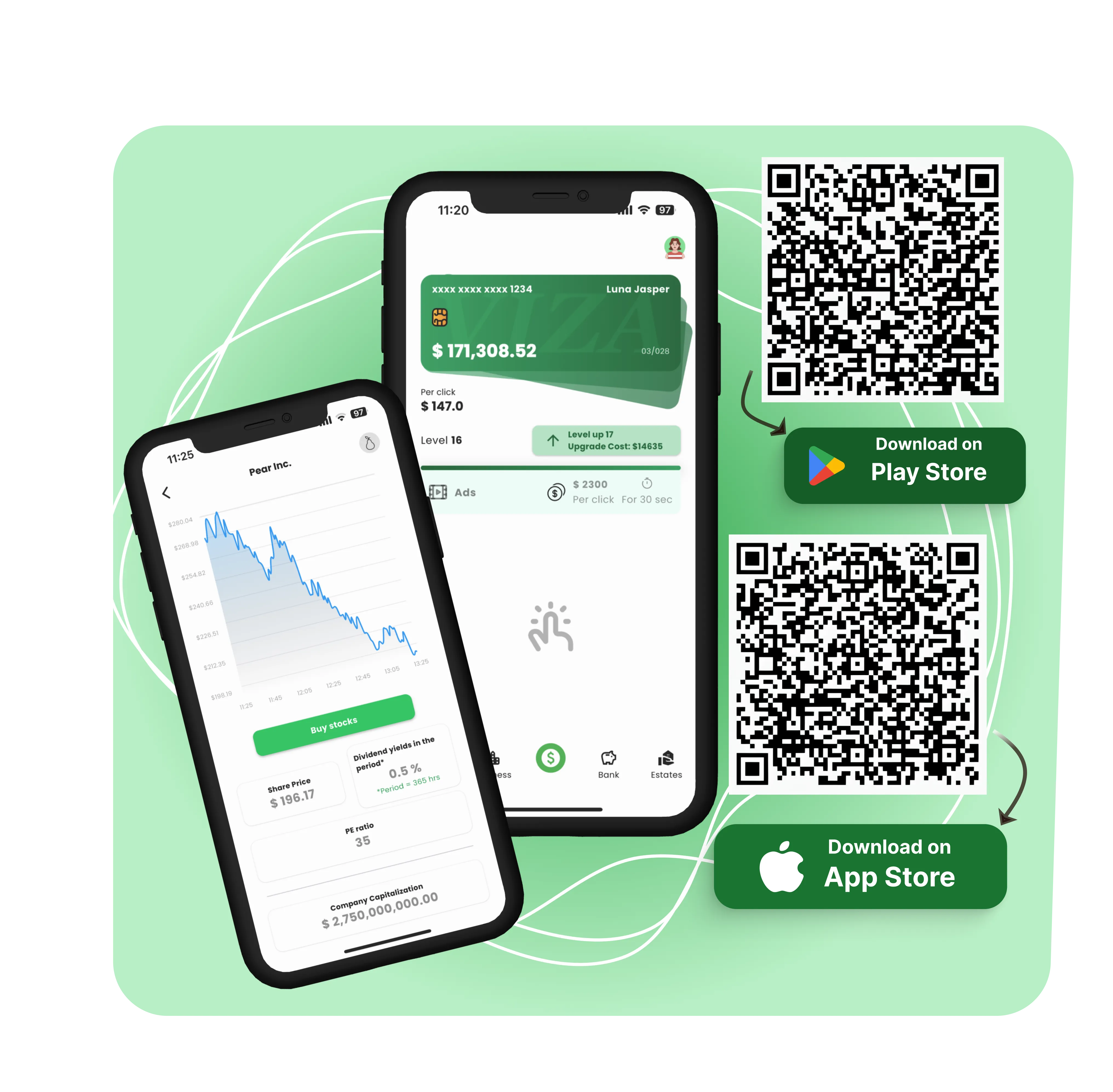
Billionaire Business Empire provides a useful example of how several business simulation mechanics can be connected inside one mobile game. Its current app listings describe it as an idle business empire simulator and include businesses, stocks, real estate, banking, economic challenges, and other progression systems.
The game's systems can be understood as several connected economic loops rather than one single money-making mechanic.
Starting With Active Earnings
One of the game's early income systems is Tap to Earn.
Each tap generates virtual currency according to the player's per-click rate. The rate can be upgraded with in-game money, and a short video-based multiplier can temporarily increase tap earnings.
This creates a straightforward active-income loop: Tap -> earn -> upgrade rate -> earn more per action.
It gives the player an immediate way to interact with the economy while establishing the first layer of progression.
Turning Capital Into Businesses
The business system changes the relationship between activity and income.
Players can select a business, review its startup cost and daily income, purchase it, and then manage it from the Business Dashboard. Owned businesses can accumulate income, which the player can collect manually. Businesses can also be upgraded or sold, and virtual taxes can apply.
The resulting loop is: Capital -> business -> daily income -> collection -> reinvestment.
This demonstrates how a simulation can turn business ownership into a repeatable gameplay system.
Adding Investments
The Stock Market introduces another decision layer.
Players can examine company information, dividend rates, price trends, and analytics before purchasing shares. Purchased shares appear in the Portfolio and can later be sold.
This means the player is no longer relying exclusively on operating businesses.
The simulation now provides another question: Should available capital remain in a business, or be allocated to an investment?
That is where resource allocation becomes more important than simple accumulation.
Adding Real Estate
Real estate creates another form of virtual asset.
Players can browse properties by type, price, and rental income, review property information, purchase qualifying properties, and collect accumulated rental income from owned holdings.
Unlike stock dividends, this system is structured around rental income.
The important mechanic is diversification of income sources: the player can build wealth through businesses as well as other asset categories.
Adding Banking
Banking introduces financing and deposits. Players can take loans after reviewing the available terms, while deposits can accrue interest according to the game's bank system.
This creates two different financial relationships:
Deposit -> capital held -> interest
and
Loan -> additional capital -> repayment over time
These are simplified game systems, but they demonstrate how business simulations can represent financial trade-offs without reproducing the full complexity of real banking.
Luxury Items Work Differently
Luxury items illustrate another useful simulation concept: not every purchase has to generate income.
In Billionaire Business Empire, luxury items are collection and status assets rather than income-producing investments. They contribute to aspects such as leaderboard positioning and profile valuation rather than functioning like businesses or rental properties.
This distinction matters because a simulation can contain assets with different purposes.
An income-producing asset supports the economic loop. A status-oriented asset can instead support progression, collection, or competitive goals.
The game's current store listings also describe luxury collections, social features, leaderboards, and virtual economic systems, while explicitly stating that its stock trading, real-estate investment, and corporate-management features are fictional game mechanics rather than real financial transactions.
What Happens When Players Make a Decision?
A useful way to understand business simulation mechanics is to follow the complete decision cycle.
Step 1: The Player Has a Resource
The player starts with some form of capital, income, asset, or opportunity.
Step 2: The Game Presents Choices
The player can spend, invest, upgrade, save, expand, or pursue another available action.
Step 3: The Choice Changes the Game State
The player's balance changes. An asset is acquired. An income rate increases. A liability may be created. A new opportunity may become available.
Step 4: The System Produces an Outcome
The selected asset or action generates income, changes value, unlocks something, or creates another consequence according to the game's rules.
Step 5: The Player Receives Feedback
The player sees updated money, income, assets, progress, rankings, or other indicators.
Step 6: The Next Decision Becomes Different
Because the player's resources and available options have changed, the next decision is no longer identical to the previous one.
This is the heart of interactive simulation.
The game remembers the consequence of the previous decision and uses the new state to create the next decision.
Why These Mechanics Feel Like Running a Business
A game does not need to reproduce an actual company to create a business-management experience. It needs to reproduce enough of the relationships that make business decisions meaningful.
For example:
Limited capital creates resource constraints.
Income creates a reason to own productive assets.
Costs force prioritization.
Upgrades create reinvestment decisions.
Investments introduce alternative uses for capital.
Risk makes outcomes uncertain.
Progression gives players a reason to continue.
When these systems interact, players begin thinking in terms of trade-offs rather than individual button presses.
That is what makes the mechanics feel like a business simulation.
Why Business Simulation Games Can Teach Business Concepts
Business games are not substitutes for accounting, economics, finance, or business education. Their value comes from allowing players to interact with simplified systems.
A player can experience concepts such as:
Revenue versus costs
Capital allocation
Reinvestment
Opportunity cost
Risk and uncertainty
Diversification
Asset ownership
Debt and repayment
Passive income
Long-term versus short-term decisions
The game converts these abstract concepts into actions. Instead of merely reading that capital can be reinvested, the player has to decide whether to spend virtual money now or preserve it for another opportunity.
That experiential element is one reason simulation mechanics can make business concepts easier to understand.
Why Business Simulation Games Do Not Perfectly Represent Real Business
A business simulation is still a game.
Real companies deal with complex accounting, employees, regulations, supply chains, customers, taxes, competitors, financing conditions, legal obligations, and economic environments that cannot be fully reproduced in a mobile game.
Games therefore simplify. They may compress months of business activity into minutes, reduce dozens of financial variables to a handful of statistics, or represent complicated markets through simple price movements.
These simplifications are not necessarily flaws. They allow the player to understand the core decision without managing every variable found in a real company.
The important distinction is between learning a concept through a simplified model and treating the game as a complete representation of real business.
The Business Simulation Gameplay Loop
Most business simulation mechanics can ultimately be reduced to a connected loop:
Resources -> Decisions -> Business or investment actions -> Income, costs, or other outcomes -> Updated resources -> New opportunities -> More complex decisions
This loop can operate at different speeds and levels of complexity.
A simple mobile game may complete the cycle quickly. A deeper simulation may make each stage more complicated and require the player to consider more variables before acting.
But the underlying principle remains the same: Your decisions change the virtual business environment, and the changed environment determines what decisions become available next.
Final Takeaway: How Business Simulation Games Work
Business simulation games work by converting business relationships into interactive systems. Players receive limited resources, make decisions about how to use them, experience the resulting outcomes, and then use those outcomes to make the next decision.
The most important mechanics usually include money, income, costs, assets, investments, upgrades, risk, progression, and feedback loops.
What makes the experience feel like a simulation is not the number of statistics on the screen. It is the connection between them.
When buying an asset changes future income, when spending capital eliminates another opportunity, when risk affects potential outcomes, or when reinvestment changes the scale of future earnings, the player is interacting with a simplified business model.
That is the core idea behind business simulation mechanics: turning business decisions into a system that players can test, manage, and learn through gameplay.
FAQs
How does a business simulation game work?
A business simulation game creates virtual business systems in which players manage resources, make financial or operational decisions, receive outcomes, and use those outcomes to make further decisions.
What do you actually do in a business simulation game?
Depending on the game, you may operate businesses, invest money, purchase assets, upgrade operations, manage resources, handle costs, take financial risks, or expand your virtual enterprise.
How do business simulation games simulate real businesses?
They simplify selected real-world relationships such as revenue, costs, investment, risk, capital allocation, and growth and convert them into rules that players can interact with.
How do players make money in business simulation games?
Players can earn virtual money through businesses, investments, sales, production, rental income, interest, or passive income systems, depending on the game's mechanics.
What mechanics make a business simulation realistic?
Consistency between decisions and outcomes is more important than sheer complexity. Revenue, costs, investment returns, risk, resource limitations, and meaningful trade-offs can make a simulation feel more realistic.
Are business simulation games realistic?
They are simplified models rather than complete representations of real businesses. Their realism depends on which real-world systems they model and how deeply those systems interact.
What is the main mechanic in a business simulation game?
There is no single universal mechanic. Most business simulations rely on a connected loop of resources, decisions, outcomes, and reinvestment, with specific systems such as businesses, investments, upgrades, or risk layered on top.
Is Billionaire Business Empire a business simulation game?
Yes. Billionaire Business Empire is listed as a Simulation game and combines business ventures with stock-market, real-estate, banking, and wealth-building systems. Its store listings describe the financial and corporate features as fictional game mechanics rather than real financial transactions.


